Smart building technology isn’t just a fleeting trend. It gives facilities managers the tools they need to help them do more with less, with actionable data that translates complex systems into something instantly clear. But how do we turn these promises into potential ROI? And how can they drive results?
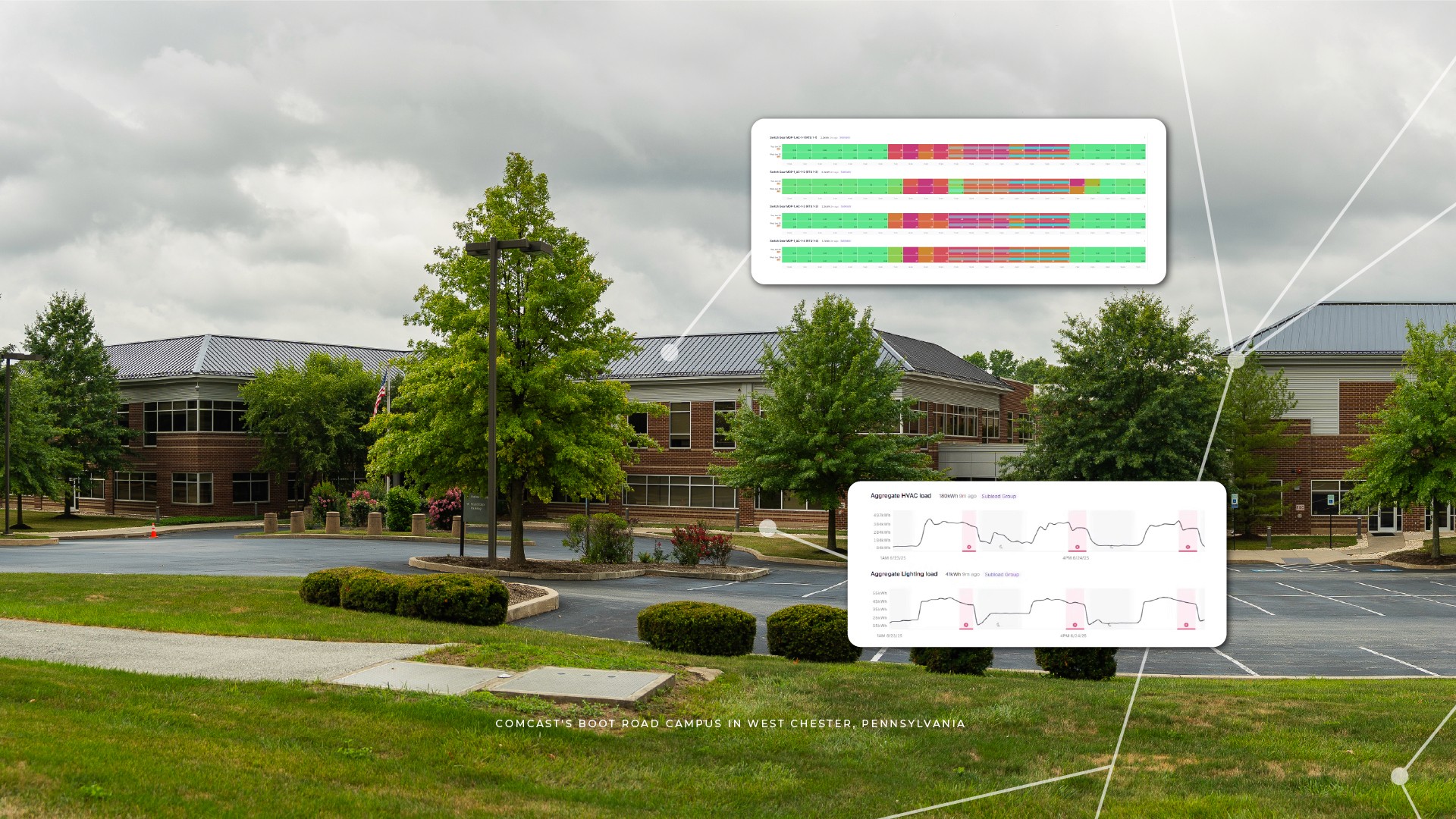
Billy Osborne, Director of Workplace Solutions at Comcast’s Boot Road Campus, a data and engineering facility with high energy demand, has spent nearly 15 years navigating these questions. Wanting to have a better understanding of the energy drivers and efficiency opportunities, he worked with the Comcast Smart Solutions team to pilot an energy monitoring and leak detection system using LoRaWan-based gateways, wireless CTs, intelligent water sensors, and a software layer from Logical Buildings. And, what started as a pilot turned into a living case study in granular energy data, quick installs, and real impact.
Matt Williams, National Sales Engineer at Comcast Smart Solutions, sits down with Billy for a deep dive into how smart building technologies have unlocked new possibilities for him and his team.
Matt: What were your initial thoughts about smart building solutions?
Billy: Smart solutions can sound like dollar signs to finance, without fully understanding potential ROI or team benefits. But, I’ve been engaged in smart building technology for a while—it excites me as a facilities professional and as a person. The Comcast Smart Solutions team reached out about a pilot, and I looked at it objectively: What does a pilot look like? What are we trying to capture? What options and technology are available? Ultimately, it was a done deal. I needed it yesterday. It’s something you don’t know you need until it’s in front of you.
Matt: Diving into some of these technologies, how does LoRaWAN compare to older protocols like Modbus or BACnet?
Billy: Those are wired solutions. You’ve got panels with relays and Modbus gear, plugging in network cables and static IPs. It’s cumbersome. With LoRaWAN, you hit a button, and it connects wirelessly. The challenge is mindset. Some facilities managers are stuck in old ways and fear costs and installation. But we’ve been satisfied with the connectivity both inside and out.
Matt: What stood out most to you about working with Comcast Smart Solutions and the Logical Buildings software layer?
Billy: When you talk about a solution like this, you get very hesitant about how much the technology has actually been proven. How much has it actually been in the field? Is it new technology that even technicians are questioning? I never got that feeling. The Smart Solutions team came to me with a wireless CT solution, and I asked for a hundred. I think most facilities managers are used to coming in and putting three on the main load of their building and calling it a day. But I want to know what every individual rooftop is doing. I want to know what the lighting is doing. I want to know what the ancillary HVAC is doing, all of that.
And the software is also a game-changer here. It’s so simple to interpret, and as facilities professionals, we want to be able to look at something at a glance and know what we're looking at without having to dive deep into the numbers. We’re installing these because we want the data. We want to know how we're operating and how we can do it better.
Matt: Have you integrated data into the BMS for automation, beyond HVAC setpoints? Any experiments?
Billy: We’ve focused on HVAC during peak demand to run efficiently while maintaining acceptable setpoints. The standard is to precool two hours before peak, blast cold air, then shut off. It worked, but the two- to three-hour energy spike was almost double. We asked: how do we avoid the spike? We tried different BMS strategies and landed on locking discharge air temperature at 65–70°F during peak instead of shutting units off. On hot, high-humidity days, we were able to effectively manage our energy usage. We trend discharge air temperature, return air temperature, and kW per unit to gauge effort and efficiency. We just installed new RTUs; each is CT’d separately, so we can compare to old units and across peers.
Matt: How does forecasting come into play with this data?
Billy: I always emphasize that energy usage is seasonal. In the winter months, I'm not using much energy because I'm using gas to heat a lot of the equipment. At other times of the year, I'm running off an economizer to bring fresh air into the building because it's at that perfect 70° temperature with no humidity. Meanwhile, in the summer months, I'm using triple the amount that I'm using in the winter months. So, understanding seasonality is crucial to smart solutions. Now that we have that trend data, I'm really looking forward to beating that forecast.
Matt: What have you heard from other facilities managers who learned about what you’re doing at Boot Road?
Billy: At a surface level, the software is going to sell the hardware, and the hardware is going to sell the software. Facilities managers saw the technologies when we were at the BOMA (Building Owners and Managers Association) Expo, and they were blown away by the data that was being presented, as well as the physical hardware that was being used to present that data.
Matt: Can you tell me a little more about some of the results and the biggest benefits for your team?
Billy: The data. I've never seen data this granular. Our setup goes beyond throwing CTs on your main service and checking a box. This level of aggregated data has been so valuable to monitor utility site usage with a new level of detail.
Ultimately, I don't think that there's a building out there that runs at 100% efficiency. Even after you have the data, you're always going to be able to do things better. That's why we have it. We can keep progressing quarter over quarter, year over year.
Matt: Why wouldn’t a facility manager want to deploy these smart solutions?
Billy: I honestly think it's misinformation, and people being scared to spend that amount of money on a solution that doesn't look pretty. Are you going to invest in something to make your building look beautiful, like new carpets or new office furniture? Or, are you going to spend that to get data on efficiency or the health of your building? And that's where finance partners will say that it doesn’t make sense. In the long run, it does, but that's where more conversations need to be had and facilities managers need to open up a little bit and explore technology that's going to better support them.
Matt: What are your final thoughts about your experience with smart technologies at Boot Road and the industry as a whole?
Billy: This industry is so untapped right now. From a facilities management standpoint, we have our BMS. We have our Modbus gear. That was smart at one point, right? We're smarter now.
Comcast Smart Solutions